
13 March 2019

High-Tech Solutions To Invasive Mammal Pests
This research team is helping to develop targeted, next-generation, socially acceptable and cost-effective new technologies to achieve landscape-scale freedom from rats, stoats and possums.
The inventory of research outputs and resources can be found here:

This research is Completed
Associate Professor James Russell
overview Te Tirohanga Whānui
The ability to cost-effectively keep these pests that threaten our biodiversity at zero density will be transformational for Aotearoa New Zealand conservation. This BioHeritage Challenge project, led by Professor James Russell of the University of Auckland, supports the scaling up of current efforts to eradicate pests by accelerating the provision of improved tools, methodologies and strategies for mammal pest control.
There is a formal national collaboration between this project, Predator Free 2050 and Genomics Aotearoa, with a research focus on the population genomics of New Zealand rats and science strategy for a Predator Free New Zealand.
These collaborations are helping the project team to complete a comprehensive report on the status of new pest control tools that are close to market in New Zealand. The report will facilitate stakeholder engagement, encourage early adoption and leverage private sector investment.
The project contributes to the BioHeritage Challenge’s goal of creating a world-class biosecurity system for Aotearoa.
highlights Ngā Mahi Whakahirahira
- Read this project’s Predator Free New Zealand Bioethics Report, released May 2019.
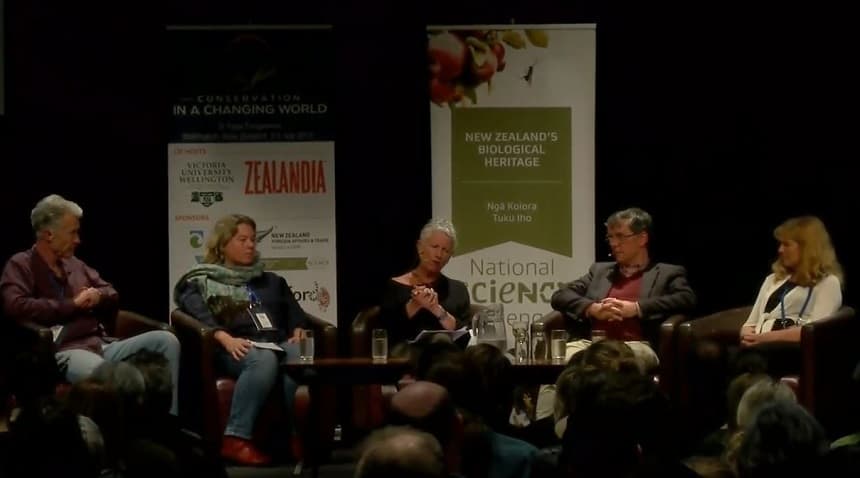
- A bioethics panel is being facilitated as part of the project, with the cross-section of representatives working on an independent report on the social, cultural and ethical issues relating to a predator free New Zealand. The report will incorporate Māori perspectives towards modern pest control initiatives.
- Articles about this research have been published in high-impact publications such as TREE and PLOS Biology (see below).
- The project also featured in the Netflix docuseries Unnatural Selection (E3 Changing an Entire Species).
Looking for more information?
If you’re looking for any outputs (papers, data etc) from this project that you don’t see on this page please visit our data repository.
Team Members Ngā kaimahi
- James Russell; University of Auckland
Related News

Resource outputs from this programme

Publication
Ethical responsibilities in invasion biology
There is a classic problem in ethics of reconciling the moral standing of collectives (e.g. populations, species and ecosystems) with the moral standing of individuals. We…
Publication
An overview of introduced predator management in inhabited landscapes.
We describe the rise of community predator control and large landscape projects aspiring for a ‘Predator Free New Zealand’, and how such an aspiration must…
Publication
Invasive alien species: denialism, disagreement, definitions, and dialogue
We recently suggested in TREE that recent elements of invasion biology discourse might be categorised as cases of more general science denialism. We did not intend…
Publication
The rise of invasive species denialism
Scientific consensus on the negative impacts of invasive alien species (IAS) is increasingly being challenged. Whereas informed scepticism of impacts is important, science denialism is…
Publication
New Zealand shouldn’t ignore feral cats
A letter to BioScience: A publication in Nature (Owens 2017) attracted our attention recently. The article refers to the ambitious, arduous, and encouraging plan to…
Publication
Past, present and two potential futures for managing New Zealand’s mammalian pests
In 2003, a review of how introduced mammals were managed as pests in New Zealand was published. Since then trends for the control of these mammals…
Publication
Eradicating mammals on New Zealand island reserves: what is left to do?
In 2016, the New Zealand Government announced a policy to rid the country of key introduced predators (possums (Trichosurus vulpecula), ship rats (Rattus rattus), Norway rats…
Publication
The ecology and management of mammal invasions in forests
Here we (1) review the ecological characteristics of mammal invasions in forests; (2) characterize the range of ecological impacts on forest communities and the economic…
Publication
Confronting the risks of large-scale invasive species control
Large-scale invasive species control initiatives are motivated by laudable desires for native species recovery and economic benefits, but they are not without risk. Management interventions…
Publication
Landholder participation in regional-scale control of invasive predators: an adaptable landscape model
We developed a spatially explicit model to estimate the effects of varying levels of landholder participation in landscape-scale programs to control invasive predators. We demonstrate…
Publication
Gene drives and rodent control: response to Piaggio et al.
Piaggio et al. recently outlined the role that new synthetic biology technologies may play in addressing a myriad of issues in conservation. One area they focused on…
Publication
Exploiting interspecific olfactory communication to monitor predators
We devised a field experiment to investigate whether dominant predator (ferret Mustela furo) body odor would alter the behavior of three common mesopredators: stoats (Mustela erminea), hedgehogs…

Report
The use of AI (artificial intelligence) in New Zealand for the sorting of images and classification of animal pest species
This report has been commissioned by the Biological Heritage Challenge to review the current development and use of Artificial Intelligence (AI) for sorting and classifying…
Report
Identifying tools and knowledge gaps to support the control of non-PF2050- targeted small mammalian predators: stakeholder perceptions of priority needs
In a move to enhance information sharing in vertebrate pest management, a Small Mammal Research Collective consisting of representatives of key stakeholder groups was established…
Report
Predator Free New Zealand: Social, Cultural, and Ethical Challenges
A bioethics panel was established to map out the landscape of social, ethical and cultural considerations surrounding Predator Free New Zealand. The panel was co-convened…
Report
Small mammal control research priorities
Results of a survey assessing the research topics that are most important to improve currently available tools for small mammal pest control.